Fire Resistant Building Materials for Colorado Homes: What Actually Holds Up

Fire resistant building materials are the part of home hardening people get most wrong, because the shopping list they build comes from product marketing instead of from how homes actually ignite in a Colorado wildfire. Nothing you bolt onto a house is fireproof. The right question is which materials buy you the most time against wind-blown embers and radiant heat, ranked by real-world performance rather than the word "fireproof" on a brochure. On the homes we assess in the Front Range foothills, the failures almost never come from a wall of flame. They come from an ember landing on the one surface that still catches. Complete Estate Care is family-owned and works these foothills directly, so this guide is the order we actually recommend materials in, and where we tell homeowners to save their money.
What are the best fireproof housing materials, ranked by ember performance?
There is no fireproof housing material, only degrees of ember and radiant-heat resistance. Ranked by how much ignition risk each removes on a real foothills home, the order is roof covering first, then vents, then the ground-floor envelope: siding, decking, and glazing. Roofs and vents outrank everything because that is where embers land and enter, and both can be upgraded for a fraction of a full re-side. Here is how the core envelope materials stack up.
Two homes on the same street, built the same year, can perform completely differently in the same fire based on nothing but their roof covering and vent screens. We have walked lots in Evergreen and along the Golden foothills where that is exactly what the aftermath showed.
Class A roofing: the one material that matters most
The roof is the largest ember-catching surface on your house, so its fire rating sets the ceiling for everything else. Roof coverings are rated Class A, B, or C, and Class A is the only rating worth targeting in the wildland-urban interface. Standing-seam metal, concrete or clay tile, and Class A rated asphalt shingles all qualify. Metal has an edge in our climate because it sheds pine needles and snow load and does not trap debris in the way tile valleys can.
A Class A roof over a needle-packed gutter is a Class A roof that will still burn. The rating protects the field of the roof, not the fuse of dry debris sitting in the valleys and gutters.
This is the material where "fireproof" marketing is most honest and least oversold, and also where the cheapest failure hides. Keep the valleys and gutters clear, add metal gutter guards, and the roof does its job.
Which fire resistant housing material is oversold, and which is worth it?
The most oversold category is intumescent coatings and spray-on "fireproof" paints marketed to homeowners. On a wood deck or wood siding they can slow ignition, but they wear, they need reapplication, and post-fire studies do not credit them the way a non-combustible substrate earns. Spend the money on the substrate, not the coating. Here is where each envelope material genuinely earns its place.
- Siding: fiber cement, stucco, brick, and stone win. These are non-combustible cladding types. Vinyl siding melts and drops away from the wall in radiant heat, exposing the sheathing underneath, and wood siding is simply fuel. On the foothills homes we scope, replacing the lower courses of wall closest to the ground with fiber cement is the highest-value siding upgrade, because that is where embers pile up.
- Decking: non-combustible or Class A rated boards. An attached wood deck is a fuel ramp bolted to the house. Aluminum, steel-framed composite rated for the wildland-urban interface, or a mineral-based board outperforms standard wood-plastic composite, which can still ignite. Just as important is closing off and clearing under the deck so embers cannot collect below it.
- Glazing: dual-pane, one tempered. Single-pane glass can crack and fall out from radiant heat before a flame ever touches it, and once the glass is gone the fire is inside. Dual-pane units with at least one tempered pane hold up far longer. This is a quiet, high-value upgrade that most homeowners skip.
- Vent mesh: 1/8-inch corrosion-resistant metal. Cover every attic, soffit, gable, and crawlspace vent with fine metal mesh so embers cannot pass through. This is the cheapest material on the list and one of the most decisive.
The 1/8-inch vent mesh line deserves its own point, because vents are the single most consistently documented ember entry route in post-fire investigations, and the fix is inexpensive. If you want it installed and inspected properly rather than stapled on, that is what our ember-resistant vent installation covers. The garage is the other opening people forget: a standard door with gaps at the panels and floor lets embers into an attached space full of fuel, which is why a fire-resistant garage door and good weatherstripping belong on the same list as siding.
What makes a fire resistant house on a Front Range foothills lot?
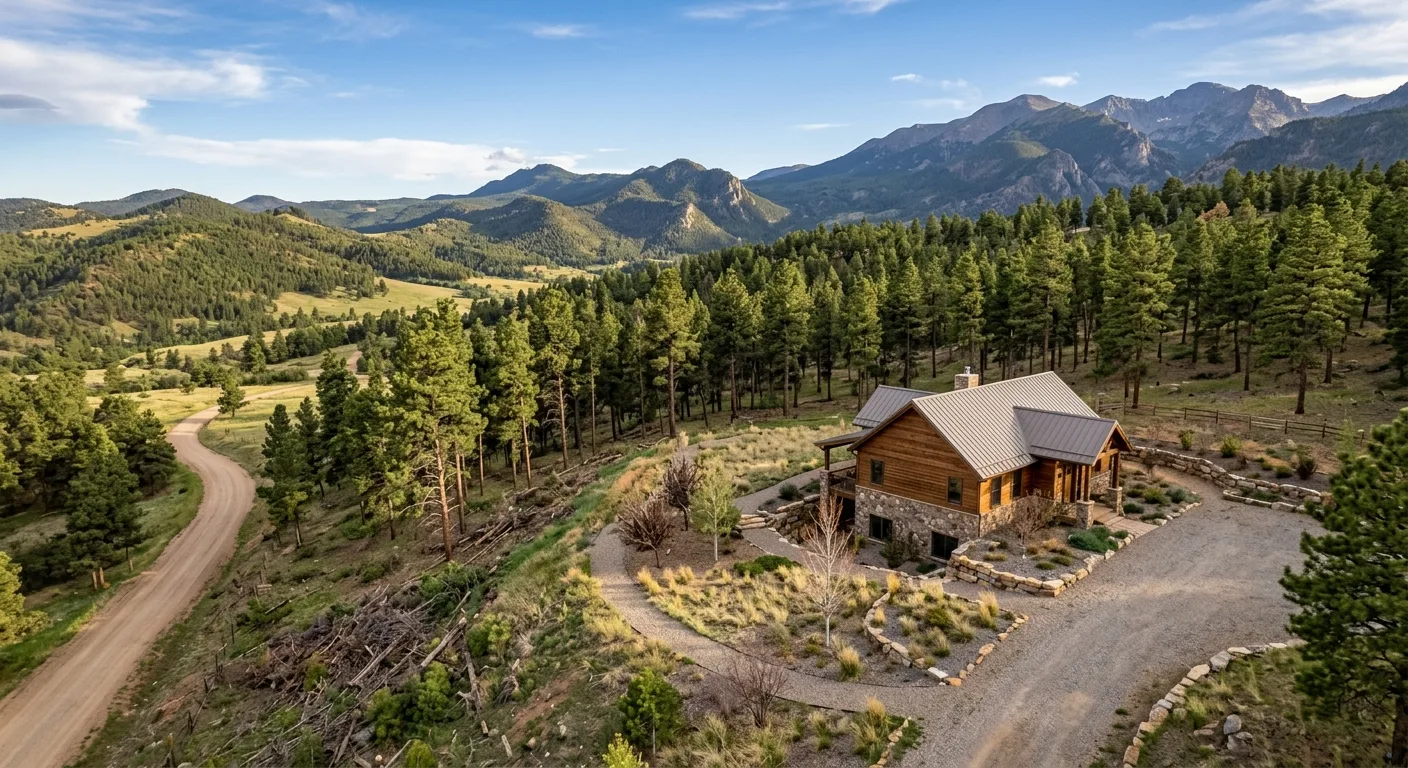
A fire resistant house is a system, not a shopping cart. On our foothills lots the specific pressures are Gambel oak and ponderosa carrying fire toward the structure, south and southwest-facing slopes that dry out and spread fire faster, and wind events that push embers into every gap on the uphill side of the house. Material choices only reach their full value when the structure and the ground around it are treated as one ignition-risk system.
That is why we never quote materials in isolation. The building envelope and defensible space get assessed together, and the structural side of that is exactly what a home hardening assessment scopes: Joe Slota walks the roof, vents, siding, decks, windows, and adjacent vegetation, then hands you a written list of vulnerabilities ranked by ignition risk so you phase the material upgrades by impact instead of by whichever product had the best ad.
When fire resistant materials are the wrong place to spend first
Do not re-side your house or buy new windows if your gutters are packed with pine needles, your vents are open, and there is bark mulch and a firewood pile against the foundation. We tell homeowners this even though it means a smaller job for us. The cheap, high-impact work comes first: clear the roof and gutters, screen the vents, and clear the first five feet. If you have not done those, a five-figure siding project is money spent in the wrong order. Handle the free and cheap steps, then let the material upgrades follow the written assessment.
Frequently asked questions
Are fireproof homes really fireproof?
No. There is no such thing as a truly fireproof home, and any product sold on that promise is overselling. What a well-built home has is fire resistant building materials that resist ignition long enough to survive an ember shower and radiant heat: a Class A roof, non-combustible siding, dual-pane tempered glass, non-combustible decking, and screened vents. Those materials dramatically raise the odds a home survives, but they work as a system alongside cleared defensible space, not as a magic coating. A home marketed as fireproof with open vents and a wood deck is not fireproof.
What is the most fire resistant material for the outside of a house?
For cladding, non-combustible materials perform best: fiber cement, stucco, brick, and stone do not ignite and do not melt away from the wall the way vinyl does. For the roof, Class A coverings such as standing-seam metal and concrete or clay tile lead. On our foothills homes, we usually recommend the roof rating first, then non-combustible siding on the lower wall courses where embers collect, because that sequence removes the most ignition risk per dollar.
Does fire resistant siding replace defensible space?
No. Fire resistant siding lowers how easily the wall ignites, but a hardened structure sitting in continuous fuel still sits in the path of a running fire. On Front Range foothills lots with Gambel oak and ponderosa, the materials and the surrounding vegetation are one system. A full assessment scopes both together, which is what a defensible space and home hardening plan does.
If you are in the Front Range foothills and want your building materials scoped and ranked by ignition risk instead of by marketing, call Joe directly at (303) 304-9997 for a free wildfire risk assessment.