
Family-owned · Denver Local
Storm Damage Restoration Built for Colorado Hail and Wind
Call directly(303) 304-9997Instant Quote
Your estimate starts here.
We'll follow up within one business day. No pressure, no upsells.
Overview
Why Choose Complete Estate Care for Storm Damage Restoration Built for Colorado Hail and Wind
Storm damage restoration in Colorado is an insurance-documentation problem before it's a repair problem, and that is the part national restoration chains get backwards. A single Front Range hailstorm can dent your siding, shred your shingles, crack your window seals, tear your gutters off the fascia, and drive water into the walls, all in fifteen minutes. Joe Slota at Complete Estate Care assesses the full extent of the damage across the whole property first, documents every hit the way a claims adjuster needs to see it, then restores the structure to hold against the next storm cycle. Because Complete Estate Care is a Division of Complete Estate Care LTD, a licensed general contractor, the same crew that runs your assessment carries the restoration through, and the paperwork lines up with the work. Call Joe at (303) 304-9997 for a free on-site storm-damage assessment.
What drives the scope and cost of storm restoration is the spread and severity of the damage across the building envelope, not any one component. A few hail-dented gutter runs on a newer home is a very different job from hail bruising across the roof, cracked siding on the north and west faces, and water already soaking the drywall near Evergreen or up in Grand County. Roof age, siding material, window condition, and whether the loss is covered all change the picture. When the damage is roof-specific, our roof repair and roof leak fix service handles the storm-torn shingles and hail-punctured roofs directly. When the hail concentrates on the cladding, our siding repair service restores the dented and cracked siding before wind-driven rain works its way behind it. Every property is different. Contact Complete Estate Care for an accurate estimate.
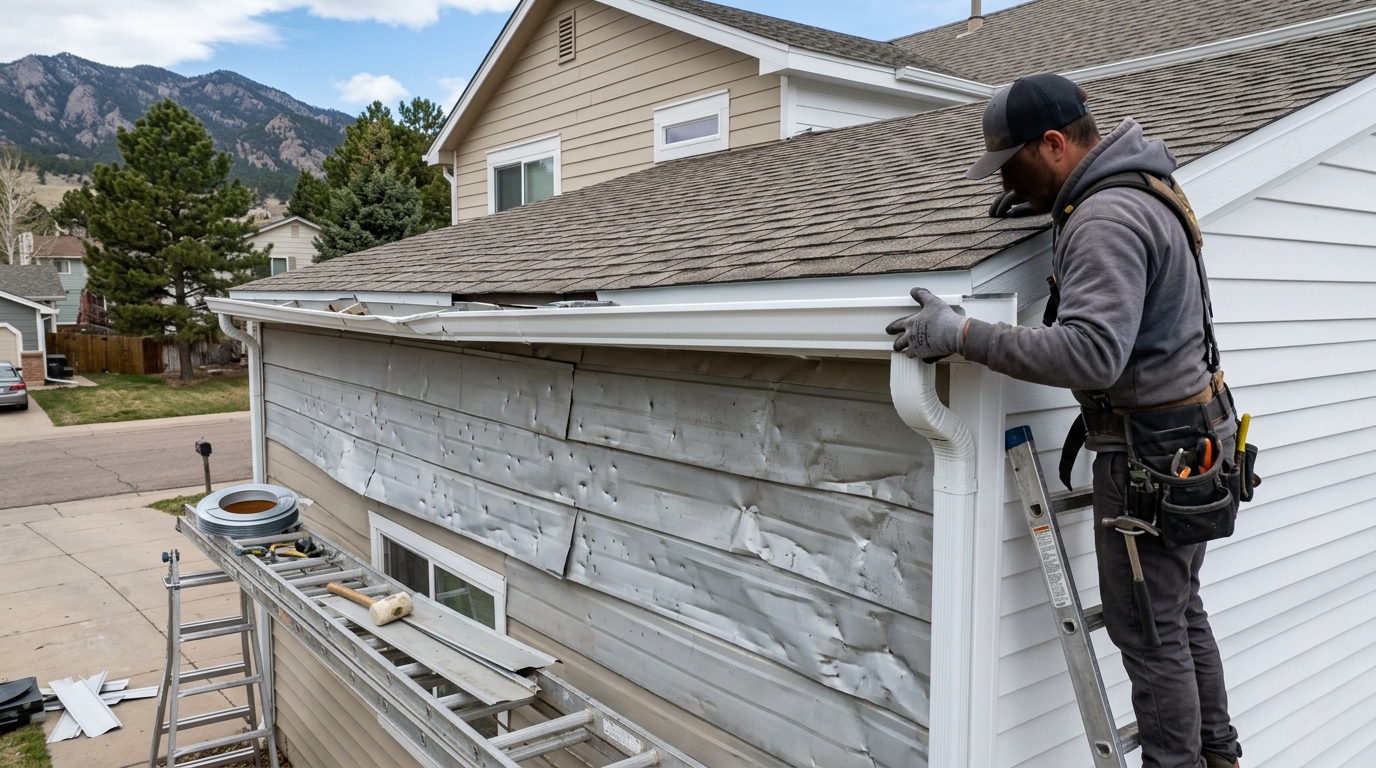
Hail-dented aluminum siding and a torn gutter on a Colorado Front Range home after a hailstorm
Storm Damage Restoration: Assess the Whole Envelope First
Here is the frame the national restoration franchises will not give you: storm damage is rarely one thing. The homeowner sees the ceiling stain or the missing shingles and thinks that is the job. On a Front Range property, that visible damage is one hit out of a dozen the same storm left across the whole envelope, and the ones you cannot see from the driveway are the ones that get a claim denied later. A storm damage restoration company that only looks at what is obvious leaves you exposed twice: the hidden damage keeps failing, and the undocumented damage never makes it onto the claim. So the work starts with a full-envelope assessment. Joe walks the roof, the siding on every elevation, the windows, the gutters, and the interior, and maps every impact before anyone talks about repairs. That map is what makes the restoration hold and what makes the claim stick.
Hail Damage Repair Across Roof, Siding, Windows, and Water Intrusion
Most storm restoration jobs on Colorado homes come down to four fronts, and each gets restored differently. Naming every one correctly is what turns a partial claim into a complete one. Here is what we are actually looking for across the property:
Siding: the damage that hides behind the cladding
Hail rarely stops at the roof. It dents aluminum and steel siding, cracks and holes vinyl, and chips fiber-cement, usually worst on the north and west elevations that face incoming Front Range storms. Those dents and cracks let wind-driven rain behind the cladding, where it rots sheathing and grows mold out of sight. We inspect every elevation and document the impacts by face, because siding damage is one of the most commonly missed line items on a hail claim.Windows and gutters: the storm damage that spreads
Colorado hail and 60-to-80-mph downslope winds crack window seals, break panes, and tear gutters and downspouts off the fascia. A failed window seal fogs and leaks. A torn-off gutter dumps stormwater straight against the foundation instead of away from it, which is how a roof problem becomes a basement problem. We check glazing, seals, gutters, and downspouts as part of the same assessment, not as separate trades you have to chase down.Water intrusion: the slow damage that costs the most
The most expensive storm damage is the water that got in after the hail opened the envelope. Wind-driven rain finds cracked siding, lifted shingles, and failed flashing, then travels inside the wall and shows up as staining, soft drywall, and eventually mold days after the storm has passed. Fast water intrusion mitigation, drying the assembly and stopping the entry point, is what keeps a covered storm loss from turning into an uncovered mold remediation.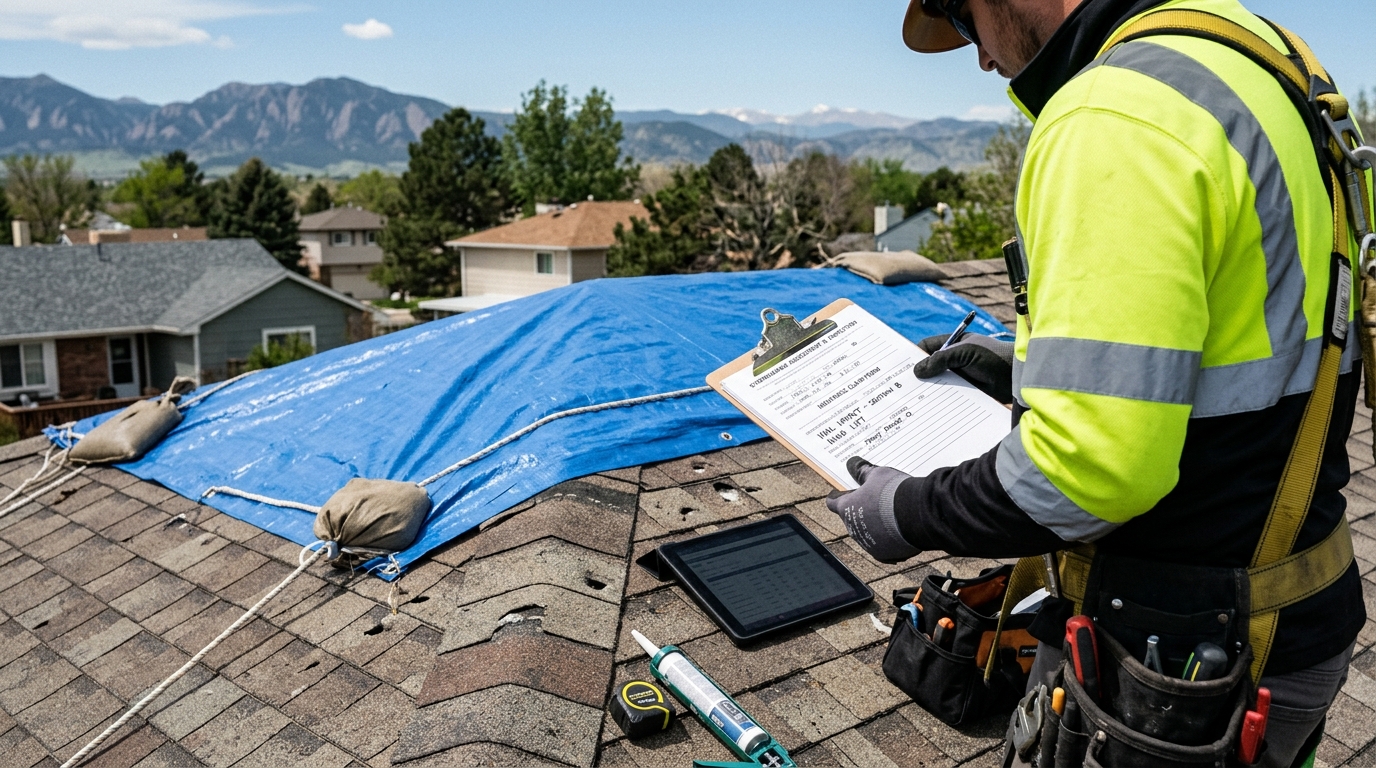
Storm-damage assessment documentation beside a tarped roof section on a Colorado home during an insurance claim
Hail Damage Roof Repair: The Component That Wins the Claim
The roof is where most storm claims are won or lost, and it is the one component we treat as its own workflow. Hail damage roof repair is a specialty, because the damage that matters, granule-stripping bruises and wind-lifted courses, is exactly the damage you cannot see from the ground.
When the storm damage is concentrated on the roof, or when a roof leak is the emergency in front of you, we handle it directly through our roof service. To repair a storm damaged roof correctly, you chalk and photograph every impact per slope, trace any active leak from the attic back to its real entry point, and document the field damage around it, not just the one shingle that is obviously gone. That documentation is what an adjuster needs and what a homeowner never has when a general restoration crew smears sealant on the wet spot and leaves.
"If a restoration bid does not document the roof slope by slope, it is not a storm claim. It is a patch, and you will be short on the settlement when the adjuster asks for the photos nobody took."
Got storm-torn shingles or a hail-punctured roof as the main problem? Our roof repair and roof leak fix page covers exactly that work. Call (303) 304-9997 and we will start with the roof.
Hail-dented aluminum siding and a torn gutter on a Colorado Front Range home after a hailstorm
When You Do Not Need Restoration (and When You Do)
When storm restoration is the wrong call: if the last storm dropped pea-sized hail, your roof and siding are under a few years old, and a walk of the property turns up no bruising, no cracked cladding, and no leaks, you do not need a full restoration and you may not have a claim worth filing. Most Colorado policies carry a separate, higher wind-and-hail deductible, so minor cosmetic dings often do not clear the threshold, and filing a claim you will not win still counts against you. We will tell you when the honest answer is to wait and watch rather than open a claim, and our guide on spotting genuine hail damage versus a door-knocker's totaled-roof pitch walks through the same judgment call for your roof. What does trigger real urgency: hail bruising across a roof slope, cracked or holed siding, a fogged or broken window seal, gutters torn off the fascia, or any sign of water inside the wall. Those do not get better on their own, and the documentation window closes as the evidence weathers away.
Will Homeowners Insurance Cover the Damage, and Documentation That Gets Paid
On most Colorado storm losses, the restoration and the insurance claim are one conversation. Getting the documentation right is the difference between a paid claim and a denied one:
Damage documentation adjusters accept
Colorado storm damage is frequently a covered loss under a homeowner's policy, but claims get denied when the damage is not documented the way carriers require. We photograph impacts per elevation and per roof slope, chalk hail bruising, record wind-lifted courses and torn gutters, and write a clean scope that matches what an adjuster looks for. No padding, no misrepresenting scope, just an honest, defensible record of what the storm actually did.Wind-and-hail deductibles and whether to file
Most Colorado homeowner policies carry a separate wind-and-hail deductible that is higher than the standard one, often a percentage of the dwelling value rather than a flat dollar amount. Knowing the true extent of the damage before you file is what tells you whether the loss clears that deductible and is worth a claim, or whether a straight repair is the faster, cheaper path. We help you make that call with real information instead of a sales pitch.One licensed contractor, full-scope restoration
Because Complete Estate Care is a Division of a licensed general contractor, one accountable crew documents the loss, coordinates with your carrier, and carries the full restoration across roof, siding, windows, and interior. You are not stringing together a roofer, a siding contractor, a window company, and a water-mitigation franchise, each pointing at the others when something is missed. Storm-damage assessment documentation beside a tarped roof section on a Colorado home during an insurance claim
Restore Once, Harden for Next Time
There is one more reason storm restoration on a Colorado property is different from restoration anywhere else: the same storm-opened envelope that lets water in also lets embers in. Wind-blown embers travel more than a mile ahead of a wildfire front and land in exactly the gaps a storm leaves behind, lifted shingles, cracked siding, and debris-clogged gutters. Restoring the envelope after a storm is a chance to close those gaps for good instead of just patching them back to the same vulnerability. Where it fits, we restore with Class-A roofing, ember-resistant details, and non-combustible materials, so the storm repair doubles as a wildfire upgrade. That is the logic behind our home hardening work: harden the structure so the next storm, and the next fire, does less damage. You can read the broader context on the Colorado wildfire history resource.
Key Facts: What Drives a Colorado Storm Restoration
The facts below come from insurance loss data, NFPA and IBHS research, and how Colorado storm damage actually behaves on a property. Each one drives a specific decision on your restoration.
The worst hail damage is the damage you cannot see
High winds open the envelope before the rain arrives
Water intrusion is the damage that keeps costing
Wind-and-hail deductibles change the claim math
Storm gaps are also wildfire ember gaps
Protection Cost Estimate
Get Your Free Storm Damage Assessment
Joe assesses every property personally, maps storm damage across roof, siding, windows, and interior, documents it the way carriers require, and tells you honestly whether you are looking at a repair, a claim, or a wait-and-watch. No call center, no subcontractors, no franchise handoff. Call (303) 304-9997 or request a free quote to get on the schedule.
Call (303) 304-9997 Free · No obligation
Or send us your info
FAQ Common questions
Frequently Asked Questions
Answers below
Will homeowners insurance cover storm damage in Colorado? +
Frequently, yes. Colorado homeowner policies commonly cover sudden storm damage from hail and wind, which is the leading cause of property damage on the Front Range. The catch is documentation and your deductible. Most Colorado policies carry a separate, higher wind-and-hail deductible, often a percentage of the dwelling value, so the damage has to clear that threshold and be documented the way carriers require, with per-elevation and per-slope photos, chalked hail impacts, and a clean scope of work. Complete Estate Care documents storm damage to that standard across the whole property and helps you decide whether filing a claim or paying for a straight repair is the smarter path. We do not pad claims or misrepresent scope.
What is the difference between storm damage restoration and roof repair? +
Storm damage restoration is the full-property version of the work: it covers the entire building envelope after a storm, roof, siding, windows, gutters, and any water that got inside, and it ties the repairs to the insurance claim. Roof repair is one component of that. When the storm damage is concentrated on the roof or a roof leak is the emergency, our roof repair and roof leak fix service handles the storm-torn shingles and hail-punctured roofs directly. When hail and wind hit the whole house at once, restoration coordinates every trade under one licensed contractor so nothing gets missed on the claim.
How do I know if my property has hail damage? +
Look beyond the obvious. On the roof, check for shingle bruising, granules collecting in gutters, and dented metal on vents and flashing. On siding, look for dents in aluminum or steel, cracks or holes in vinyl, and chips in fiber-cement, worst on the north and west faces that take incoming Front Range storms. Check windows for cracked or fogged seals and gutters for dents and sections torn off the fascia. Inside, watch for staining or soft drywall in the days after the storm, which signals water got behind the envelope. Much of this is hard to see from the ground, so a professional assessment that documents damage per elevation and per slope is worth it even if the house looks fine from the driveway.
There is water inside my wall after the storm. How fast do I need to act? +
Do not wait. Wind-driven water that entered through cracked siding or lifted shingles spreads through the wall assembly and grows mold within a couple of days, which can turn a covered storm loss into an uncovered remediation. The first step is stopping the entry point and drying the assembly, then documenting the intrusion for the claim. Complete Estate Care handles the water intrusion mitigation and the envelope repair together, so the leak that let the water in gets fixed at the same time the interior gets dried and restored. If water is actively coming in, get it assessed before it spreads.
Should I file an insurance claim after a hailstorm or just pay for the repair? +
Start by getting the full extent of the damage documented before you file, because most Colorado policies carry a separate, higher wind-and-hail deductible. If the loss is minor cosmetic denting from small hail and clearly will not clear that deductible, filing may cost you more in claim history than it returns, and waiting and watching is often the honest call. If there is bruising across a roof slope, cracked siding, failed window seals, torn gutters, or water inside the wall, the damage almost always justifies a claim and the documentation window is closing as the evidence weathers. Complete Estate Care assesses the property and tells you which side of that line you are on with real information, not a sales pitch.
Can storm restoration also make my home more wildfire resistant? +
Yes, and on the Front Range it is the smart way to do it. A storm-opened envelope, lifted shingles, cracked siding, and debris-filled gutters, is also an ember-entry point in a wildfire, since wind-blown embers travel more than a mile ahead of a fire front. Restoring after a storm is the natural moment to close those gaps for good with Class-A roofing, ember-resistant details, and non-combustible materials, so the repair doubles as a wildfire hardening upgrade. Because Complete Estate Care is a Division of a licensed general contractor, we can carry the storm restoration through and tie it into a broader home hardening plan on the same visit. Call (303) 304-9997 to discuss your property.